What you can legally say to a government buyer before the RFP
What you can discuss with a government or education buyer before a solicitation posts, what changes the day it does, and the limits that always apply.

Many sellers view contacting a government buyer before an RFP is posted as somewhere between risky and forbidden. The opposite is closer to the truth, and that hesitation quietly costs deals that were winnable.
What follows is the conduct side of pre-RFP selling: where that line falls, and how to stay useful to a buyer without handing anyone grounds to remove you from the competition.
TL;DR: What can you say to a government buyer before the RFP?
Before a solicitation is posted, you can generally discuss a buyer’s needs, budget cycle, timeline, and what the market can deliver. Once it is posted, contact generally has to go through the single contact person named in the solicitation. The limits that apply throughout concern gifts, non-public information, and any advantage a competitor could not also obtain.
Those limits govern conduct, not vocabulary, which is why the posting date matters more than the exact wording of your outreach.
The line that changes everything: when the solicitation posts
Rules for pre-solicitation contact differ by state, by entity, and by the purchase in front of you. The guidance in this article describes how that contact generally works in public procurement and is not legal advice. Confirm the specifics with the procurement office involved, or with your own counsel, before you act.
An RFP publication turns an open conversation into a channeled one.
Under New York State Finance Law, a restricted period begins with the earliest posting of the written notice, advertisement or solicitation and ends only with final contract award and approval by the entity and, where applicable, the state comptroller. It applies to procurements with an estimated annualized value above fifteen thousand dollars.
The definition of contact is broader than sellers expect.
That statute defines a contact as any oral, written or electronic communication where a reasonable person would infer it was intended to influence the entity’s conduct or decision on the procurement.
During the restricted period a bidder routes contact through the designated contact, subject to the statute’s listed exceptions for things like submitting a bid, written questions circulated to all bidders, and protests. The restriction is not limited to the procuring office. Reaching a member, officer or employee of another governmental entity is itself a violation, with an express carve-out for a state legislator or legislative staff acting in an official capacity.
A knowing and willful violation produces a determination of non-responsibility, and the bidder and its related entities cannot be awarded that contract except in narrow circumstances involving public safety and sole-source need.
This means, before any outreach, check whether a solicitation covering your category is already live with that entity. If it is, route everything through the designated contact and say so plainly to anyone who asks you for a side conversation. If it is not, you are in the open window where the real work happens.
What you can do before the window closes
Buyers establish specific channels for vendor input, and using them is both allowed and expected.
Responding to a request for information is the most direct example. Attending an industry day or a pre-solicitation conference, commenting on a draft solicitation while the requirements are still being developed, and reaching out to buyers based on buying signals are valid and proven ways.
None of this is a loophole.
Often buyers build these channels deliberately, and federal rules encourage using them outright.
For example, Federal Acquisition Regulation 15.201 encourages exchanges of information among all interested parties from the earliest identification of a requirement through receipt of proposals, and states that the purpose is to improve understanding of government requirements and industry capabilities on both sides, so potential offerors can judge whether and how they can satisfy the requirement.
The Department of Labor’s published vendor communication plan puts the same point in practical terms, saying early exchanges can provide insight from industry that could improve the quality of that agency’s requirements and processes.
We strongly recommend public sector GTM teams build the relationship early, often months before the RFP posts. There’s less competition and, as a result, the win rate of public sector contracts is higher.
What stays off-limits at any stage
Some conduct is never acceptable, whatever stage the purchase has reached.
Gifts, meals, entertainment, and anything else of value fall into this category.
Federal Acquisition Regulation 3.101-2 says that as a rule no government employee may solicit or accept any gratuity, gift, favor, entertainment, loan or anything of monetary value from a firm seeking that agency’s business, with limited exceptions set in agency regulations.
The gratuities clause lets the government terminate a contract when it finds a gratuity was offered to win favorable treatment.
Asking for or accepting information competitors do not have is barred on the same always-on basis, under the procurement integrity rules, which restrict obtaining another firm’s bid or proposal information and the government’s source selection information before award.
Assume everything you write becomes public
Treat every message you send a government buyer as public.
Records statutes differ by state in what they cover and what they exempt, and the breadth of the definitions is the part sellers underestimate.
Florida defines a public record at section 119.011 of the Florida Statutes to include documents, papers and letters of any physical form or means of transmission, made or received in connection with the transaction of official business by any agency. Nothing in that turns on whether a message was marked confidential or sent from a personal account.
Behave accordingly. Write each message as though a competitor will read it during a records request, because one may.
This means, keep disparagement of other vendors out of writing entirely, keep pricing speculation out of email, and keep your account notes free of anything you would not want quoted back to the buyer.
How federal rules differ from state and local
The real difference is documentation: federal practice puts the engagement on the record.
Agencies are required to document the results of their market research, and the presolicitation exchanges happen as scheduled events rather than private favors.
Agencies such as the Department of Labor publish a communication plan setting out how and when vendors may engage. A seller can often tell where a federal requirement stands by reading rather than asking.
SLED buyers document far less of it.
No general requirement equivalent to the federal market-research rule obliges a county or district to document its research or publish an engagement plan, and while a statewide code may govern state agency purchases, county, city and district buying is set by local ordinance that is often not gathered in one place.
Meaning, in SLED, the seller has to ask rather than read.
Find the accounts still in the open window
All of this depends on one piece of information that is harder to obtain than it sounds: knowing which accounts in your territory are still pre-solicitation.
Because by the time a solicitation appears on a portal, the conversation that shaped the RFP will often already have taken place without you.
So watch the records that move before a solicitation does.
Budget adoption dates tell you when money is committed, board agendas show a purchase being discussed, strategic plans name a priority before it is funded, and contract end dates mark the renewal-or-rebid decision the buyer is working back from. Each of those carries its own date, and each one tells a rep when an account is worth a call.
Doing that by hand across a territory is the part that fails. Those records sit on each entity’s own site and each one goes stale on its own schedule, so a rep checking accounts manually will miss windows that were open.
That’s one of the reasons we created Starbridge.
Starbridge is the AI GTM platform for companies selling to the government, K–12, and higher education, helping teams prioritize the right accounts, engage the right people earlier, and identify high-intent opportunities before the competition.
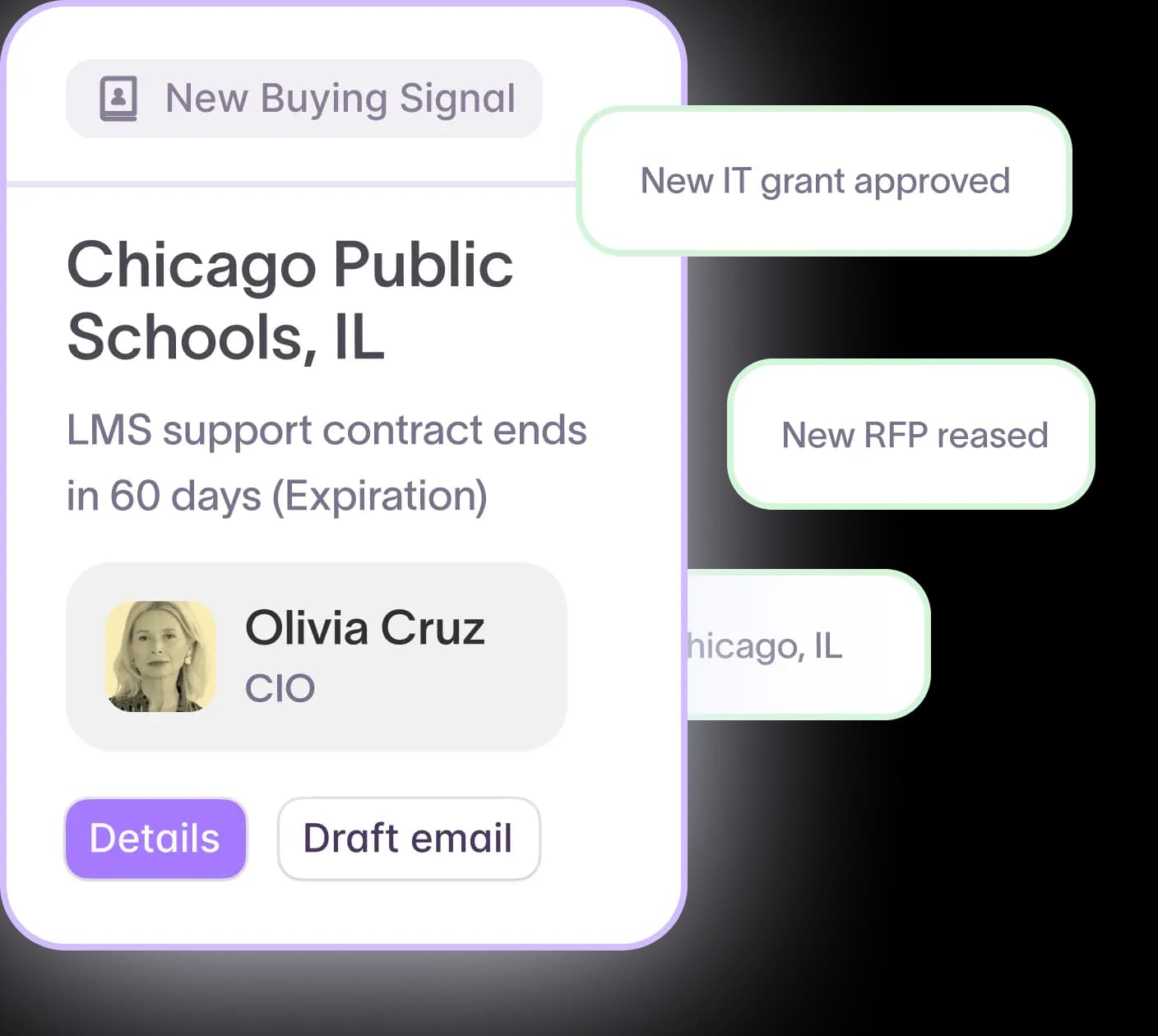
Starbridge’s Buying Signals Monitor watches budgets, board activity, contracts, grants, and procurement data across state and local government and education entities.
GovWell booked five meetings in its first week and now sources 15% of its qualified pipeline through Starbridge. Book a demo today to learn more.
Sell inside the window, not around the rules
The answer to what you can say before the RFP is mostly about when you say it.
Before a solicitation is posted, you can talk with a government or education buyer about their needs, their constraints, and their timeline, and federal rules encourage exactly that exchange.
After it is posted, your access narrows to one designated person, and in New York the penalty for ignoring that twice runs to a four-year bar on covered state procurement contracts.
Timing changes who you can call. It does not change the rest. In short: do not send gifts, respect the procurement process (and accelerate it legally with contract vehicles), and write every email as though it will be published.
The advantage goes to sellers who show up while the requirements are still open. To see which accounts in your territory are showing budget and board activity right now, book a demo.
Frequently asked questions
During an active procurement you can usually talk to a government buyer only through the contact named in the solicitation. Many entities treat communication with anyone else as a violation, including questions that seem administrative. You can ask the designated contact whether other channels are open before using them.
A procurement blackout period is the stretch during which vendor contact is restricted, typically beginning when a solicitation is first posted publicly and ending at award. Names and boundaries differ by jurisdiction. New York’s period runs to final award and approval, Florida’s statewide rule ends 72 hours after the notice of intended award, and local codes set their own.
In almost all cases, no. Gifts, meals, and entertainment are restricted under federal policy and under state and local gratuity rules, and the thresholds vary by jurisdiction. Working out which one applies takes longer than simply declining. Offer to meet at their office instead.
When a vendor contacts someone other than the designated contact during an open solicitation, the award itself can be at risk. For example, in New York, a knowing and willful violation brings a determination of non-responsibility, and a second finding within four years bans the bidder for four years.
Yes, responding to a request for information is usually worth it, because it is one of the ways to influence requirements before they are fixed. Agencies use the responses to shape acquisition strategy, and a specific, well-documented answer carries weight. Treat it as a chance to explain constraints and cost drivers rather than to pitch.
Explore our use case library
 Automate account research with AI agentsStop manually researching accounts. Starbridge AI agents automate account research by monitoring buying signals 24/7 and surfacing the right contacts.
 Identify competitor contract expiration datesThe RFP is usually a formality. Starbridge surfaces competitor contract expiration dates so your reps reach accounts before the renewal cycle closes.
 Create a conference campaignTurn conference badge scans into pipeline. Import your contact list, surface buying signals across every account you met, and follow up with context.